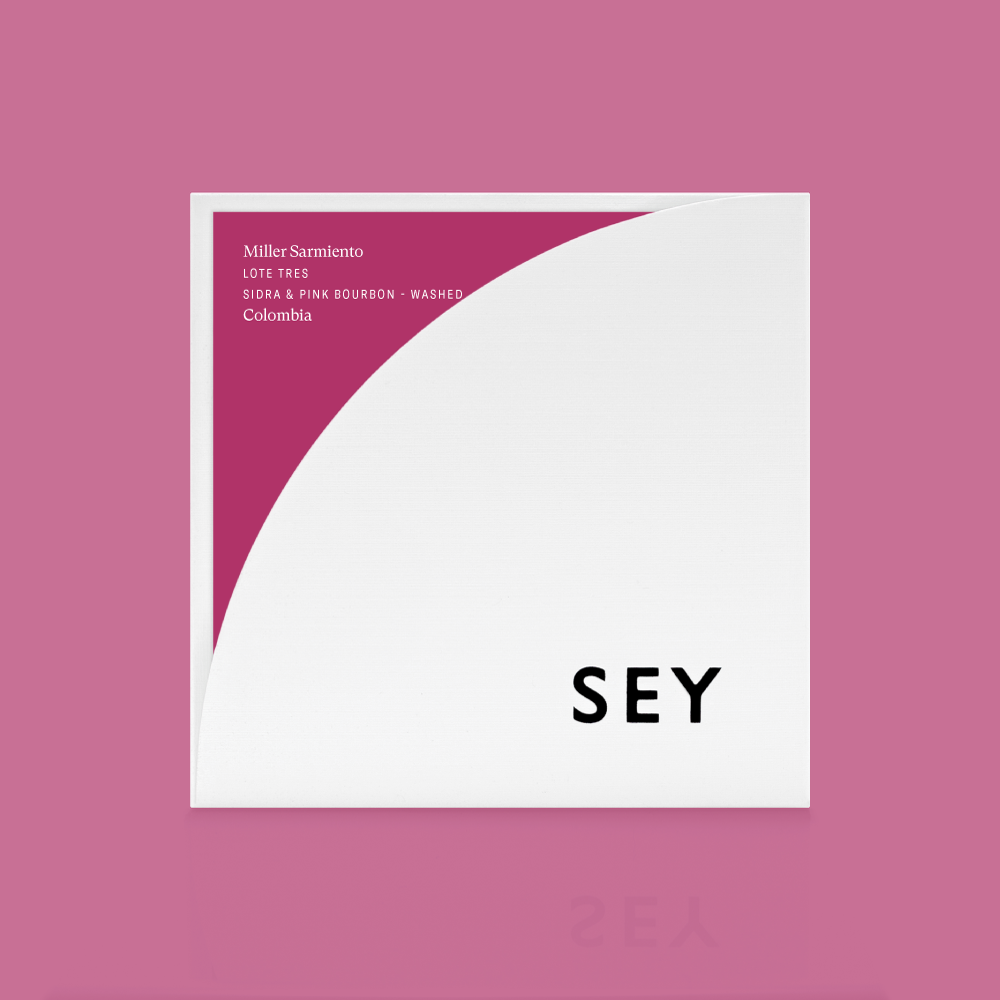
This is a unique blend from a new producer—an uncommon combination of Sidra and Pink Bourbon. These varieties are typically separated, but the small size of each lot created an opportunity to do something different. In the cup we find strawberry jam, lemon zest, and panela.
Sidra & Pink Bourbon
Santa María, Huila
1,952 masl
August, 2025
Hand-picked at peak ripeness. Floated to further remove defects. Held in-cherry overnight. De-pulped. Dry-fermented for 36 hours. Washed. Dried on raised beds until moisture content reaches 10.5%.
ABOUT MILLER SARMIENTO
This is one of those producers and coffees we had never encountered until this season. While the vast majority of our coffees now come through well-developed supply chains and from producers whose work we have known for years, a small percentage come from entirely new relationships—like this one with Miller. It is always exciting to discover and release coffees from producers we have never worked with before, and each time it happens, we are reminded of how much there is still to explore.
ABOUT SIDRA & PINK BOURBON
Both Pink Bourbon and Sidra are Ethiopian Landrace varieties, though their exact origins remain unclear. Pink Bourbon, grown primarily in and around Huila, Colombia, has been genetically identified as Ethiopian in origin, but without a larger genetic database, its lineage cannot be more precisely defined. Similarly, the variety referred to as Sidra in Ecuador has also been confirmed through genetic testing to be an Ethiopian Landrace.
Ethiopia is widely regarded as the geographic origin of Arabica coffee, and over 60 distinct varieties have been identified there, making it the most biodiverse coffee-producing region in the world. How these varieties have made their way into other origins varies greatly, and ongoing research continues to explore their movement and adaptation. As climate change makes coffee cultivation more challenging, many new varieties and hybrids are being developed using Ethiopian Landrace germ-lines as a foundation.
Pricing Details

Farm Gate (LOCAL; PARCHMENT)
3.9MM COP/Carga
Farm Gate (USD; GREEN)
~$10.02/KG

FOB
$13.36/KG

DDP
$16.26/KG
The cost of getting a coffee from cherry to beverage varies enormously depending on its place of origin and the location of its consumption. The inclusion of price transparency is a starting point to inform broader conversation around the true costs of production and the sustainability of specialty coffee as a whole.